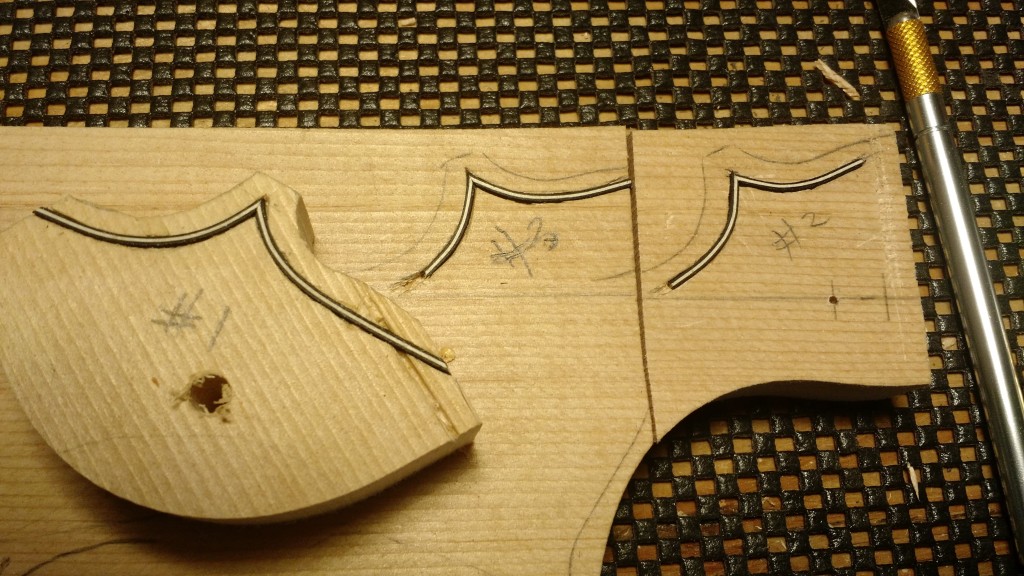
I made two more corners this morning and had something of a breakthrough with the second one (#3 overall). If you’re a new luthier reading this, I list the steps that worked for me below.
Here’s another pic of #2.
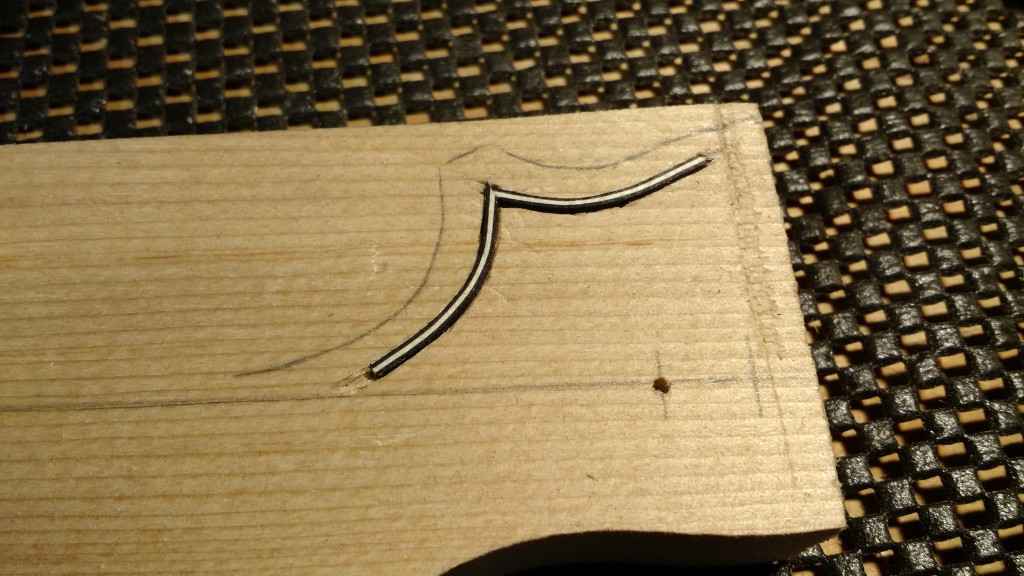
I don’t like this one much and it was a royal pain to make. The main problem I have with it is the interior angle. See how it’s almost 90 degrees? Not nearly as elegant as the curve in #1 and #3. The main reason for that, I realized, is that the tip of the corner is too far from the edge of the corner. In both the two I am happy with, the distance is about 3.5mm or so. On this one, it’s about 5mm.
#3 was the quickest of the three by far, which makes me hope I have arrived at a workable method. So step one in that method is definitely to watch this video, because I am doing it about 95% the way he demonstrates:
So my version is a little simpler because I am not trying to make a bee sting. When I do it next time I’ll try to remember to take pics.
- Mark apex of corner. Given that I am not doing a bee sting*, I don’t angle it toward the C bout. I am shooting for centered and about 3.5mm from the edge of the plate.
- Mark the purfling channel with a marker up until about 1.5cm before the corner. In my #2 and #3, I don’t have a real corner so I skip this obviously.
- Draw the outside (closer to the edge) of the channel between the marking for the apex and the marking made in the step above.
- Use a 25mm or so #6 gouge to make the preliminary cut between apex and the end of the marking you did in step 2. This step takes finesse. You’re probably not going to use the whole length of the gouge, and it may not follow the line you drew exactly. If it’s way off, your line was not drawn right. Do the other outside edge of the channel the same way.
- Erase the pencil lines you made and redraw the arcs to match the gouge mark.
- Cut the outside channel line.
- Draw the inside channel line and cut it.
Pay close attention to how he cuts the miters in the vid because it’s genius. He uses a set of measurements to determine his because his corners are probably all exactly the same. My improvised version of this works too though: measure the distance between the apexes
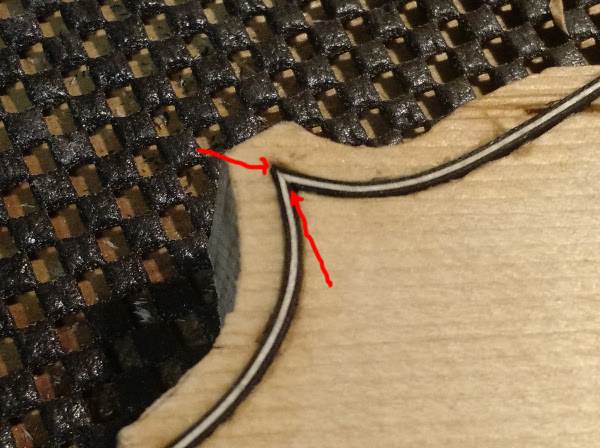
Mark that distance on a hard board like Mr. Sora does, and then cut the angle to match that distance. Basically do what he does, but measure each corner to determine the length of the mitre.
* I feel like the bee sting is something I want someday in my purfling corners, but I have no business messing with doing them now. Maybe I’ll try when I get to violin #10.