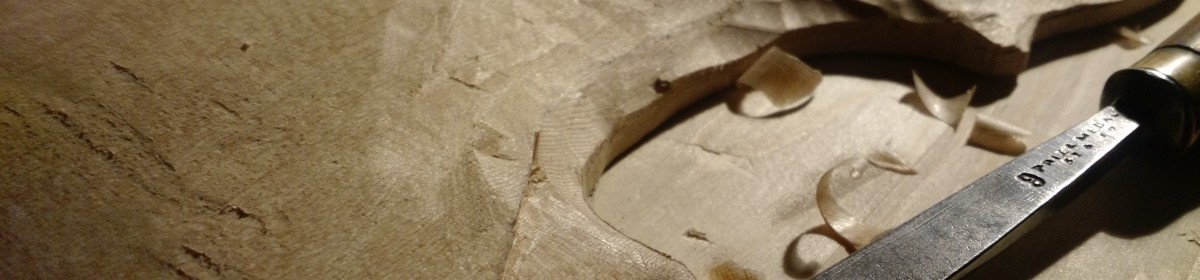
So with the rough arching done, the next step was to use files to get the edges of the top plate even and down to the final dimensions. I left the corners a bit unshaped as I’ll eventually use a knife to do the final shaping. I have looked at a whole bunch of violin corners (seriously like 100+) in the last few weeks with two results: 1. I am getting a better idea of what good corners should look like 2. I know the corners on the Maggini are not going to be good. But first one and all.
So edge mostly set, it was time to move on to making the platform.
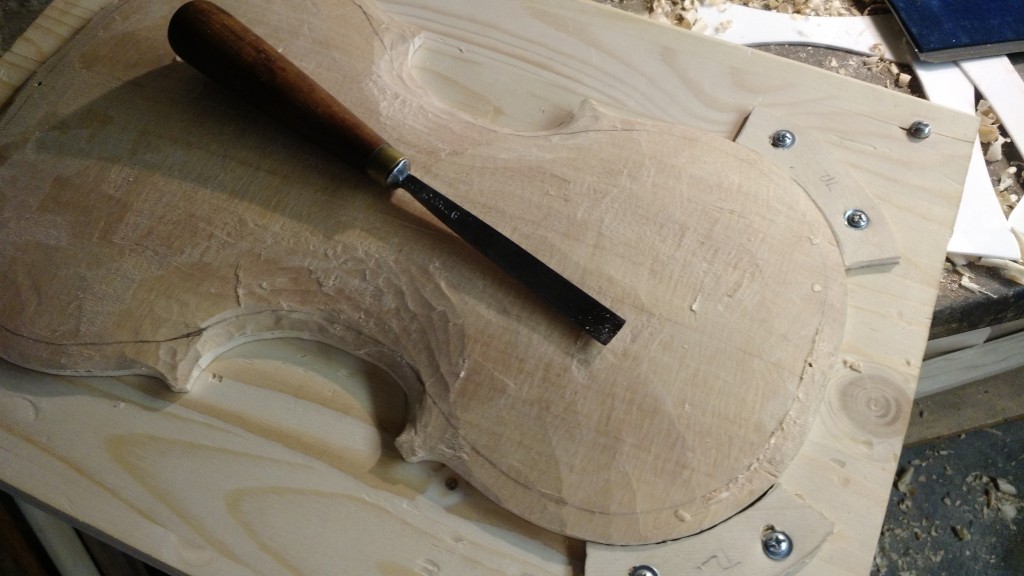
In the photo you can see the line I’ve scribed with a compass: 9mm from the edge in the upper and lower bouts and 7mm in the C bouts. My next task is to make the space outside the line more or less flat. Thats where the purfling will go, and then it’ll be fluted to create the recurve of the arching.
I don’t think anyone would say a violin is a simple object, but when you start to pay close attention to one, you find out that they are much more finely shaped than you might have guessed. Anyway, if I manage to do it well, I’ll post a pic when it’s done. On to making the platform:
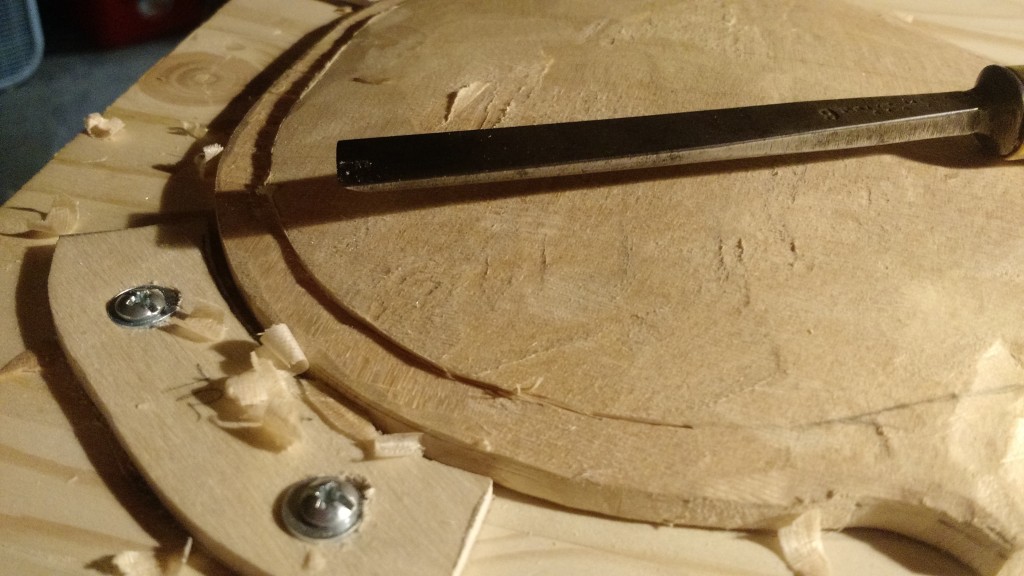
This is, I think, the most detailed work I’ve done on the fiddle yet. By that, I mean that each time I move that gouge on the wood, it needs to be done right. If I slip and dig too deeply on an edge, that mark will be in the final instrument. There is more or less no room for screwing up. I am just over 1/3 done with the outline now and it has probably taken me 2 hrs.
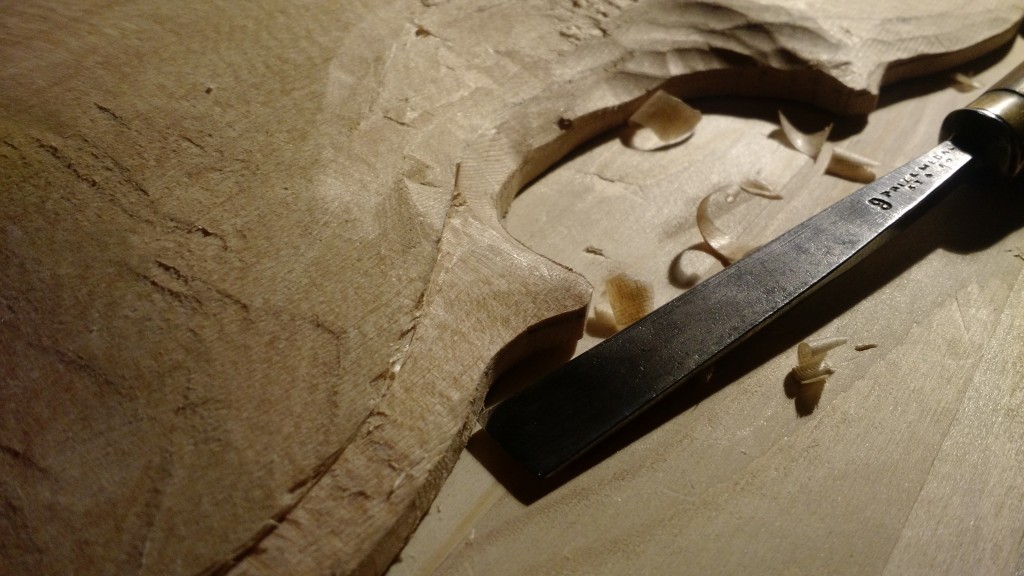
That gouge is my new best friend. It was made in England by JB Addis (a blacksmith) in the early 1880s. This is also a good time to confess to a developing problem with antique steel like this. Ebay is my enabler. Quality old Sheffield steel like this just sharpens up so nicely, and it’s fun to use a tool knowing there is has been in use for 130 years. For those of you starting your fiddle making journey: the best part of these cool old tools is that they’re also usually cheaper than buying new. That gouge was about $25 because it is particularly old, but I picked up a really nice Sheffield steel 1″ gouge for $10. It’s similar is size and sweep to the one I’ve been using for arching, but that one was $65. And the old one is way cooler looking.