It’s story time so sit back (or hit the jump for the pics) and pour yourself something to drink.
I think I was 8 years old the summer I learned to carve wood, which would make it the first of a series of summers that we spent a few weeks camping in our RV in northern California. I think that summer we split our time between Shasta Lake and Lake Trinity (or Claire Engle Lake, I have never learned why the lake has two names). In summers that followed, we’d skip Shasta and just return to Trinity. The campground we stayed at was called “Wyntoon,” and it was the happiest spot of my childhood.*
I had a small penknife that summer — I’m not sure my parents bought it for me there or not — and I suspect when I saw the guy sitting outside his RV carving wood a few spots down from us I probably went up and showed it to him. I was a very friendly kid. It turned out that the man was working on a Kachina doll, and looking back on it I suspect he probably was funding his retirement by making them. He had quite a few, and they were very well crafted.
The man asked me if I’d like to learn to carve things, and of course I said yes. I actually had quite a knife collection at the time, and I was excited I would get to use them for something. I remember that the first thing he taught me was the a dull knife was dangerous. He sharpened mine up until the blade was like a mirror. Then he gave me a block of wood about 6″ long and 3″ wide that had the outline of a mouse traced on it. “Make that like this,” he said, showing me the smooth simple mouse-shaped final product. It was painted as expertly as his dolls.
I spent the next week carving the block back at our RV and occasionally sitting underneath the awning of his. Occasionally he’d give me advice about a different way to hold the blade. Mouse ears are thin, and at some point I chipped one off. He showed me how to glue it back on, and I figured out that wood glue is basically magic. The end of the trip came before I finished the mouse, but I promised the guy I’d keep working on it.
And I did. I never ended up painting it, but I finished the carving and sanded it all up. These days it’s worse for wear with two missing ears and most of its tail. But when I look at it I remember what it felt like to bring that shape out of the block of wood. At first it just seems ludicrous that the rectangular block of wood could ever become something curved and precise. There is something deeply intriguing about seeing the vision of a final product being slowly drawn into reality out of raw materials. If you paint or draw (or write, actually) you’re familiar with the process of honing raw material into a final product. There’s something unique to carving or sculpting, though, and I think it’s that you’re working in three dimensions. You’re bringing something you can see and touch into existence one slice of wood at a time.
This morning, I hit the stage in carving the top when it suddenly felt like I was shaping a violin top not hacking away at a chunk of wood. I am not sure what it was, maybe that I was doing all the work with a finger plane, but it felt like every bit of wood I removed revealed a little more violin.
Here’s where I left it.
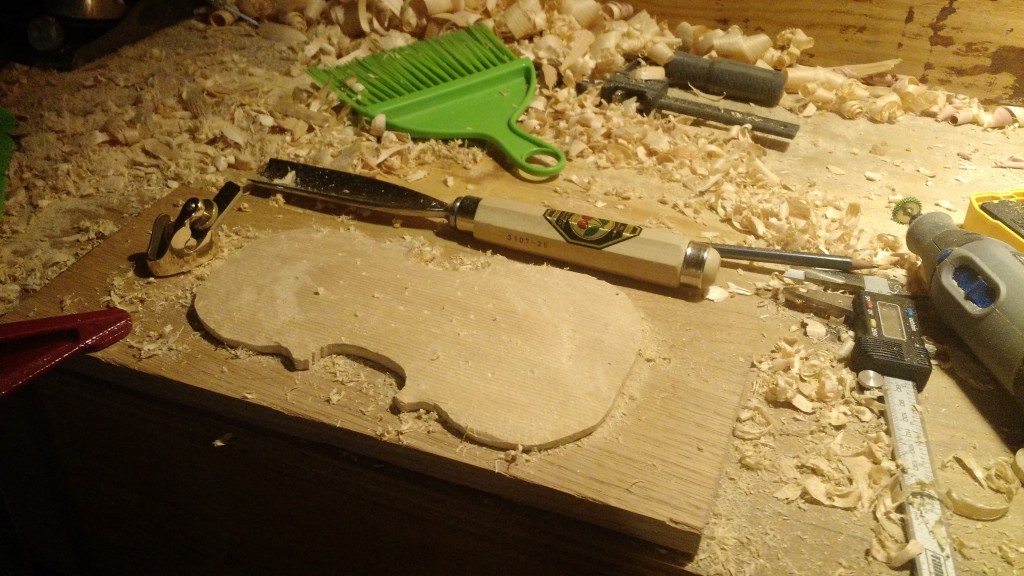
By the way, you’ll notice that often the shop is kinda dark. That’s on purpose: violin shops are traditionally lit by single light sources especially during the carving. Having oblique light helps to see the contours of what you’re working on.
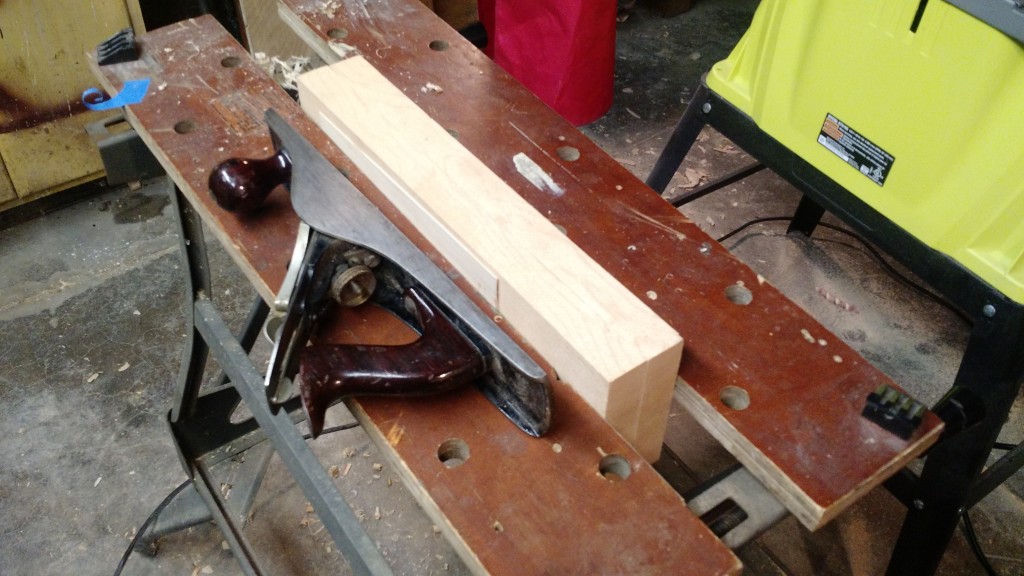
My fingers are still pretty shot so I limited the carving time and decided to join the wood for the top. Here’s my fancy joining setup:
And here it is after use
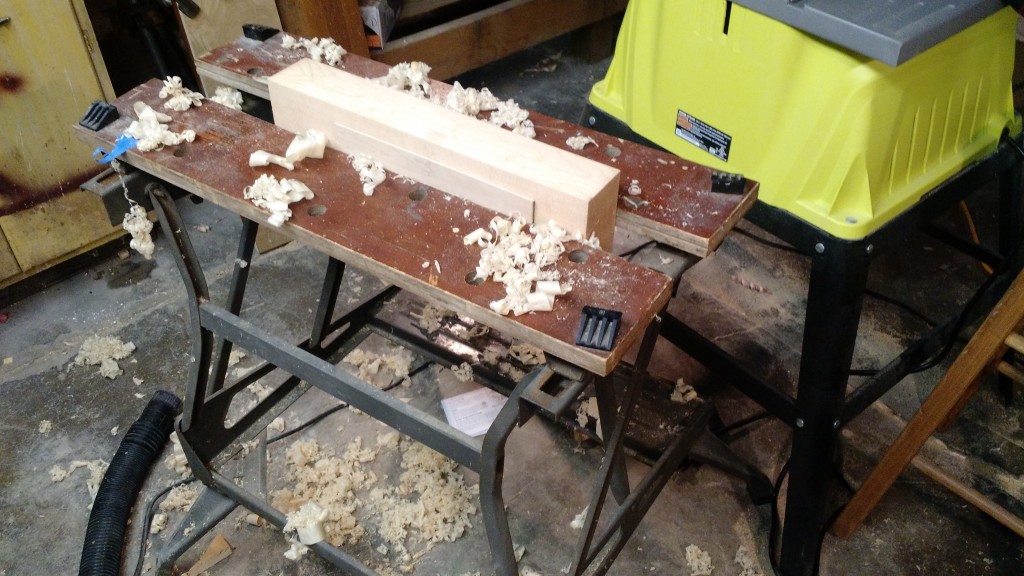
It took a few tries before I got a good joint. I remember reading somewhere that tissue thin shavings are way too thick, but it’s true. They need to be see-through. Once I was satisfied with the fit, I glued it up employing the rub joint again. I used a bit thicker glue this time and it bit with just a few seconds of rubbing.
I didn’t notice but the one pic I took of the board glued up is kinda out of focus.
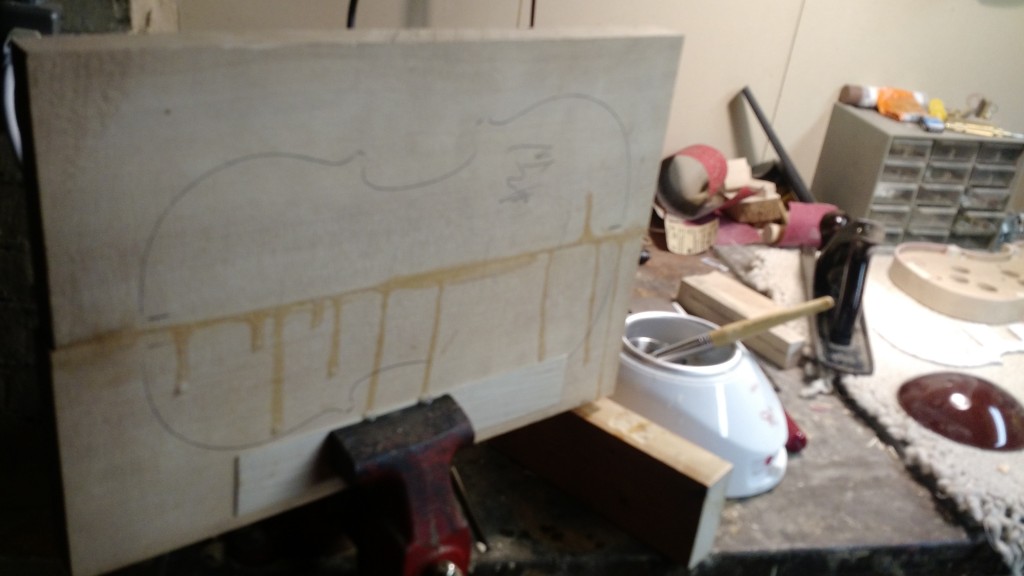
That’s not the real outline of the fiddle, by the way, just marks made by the wood seller.
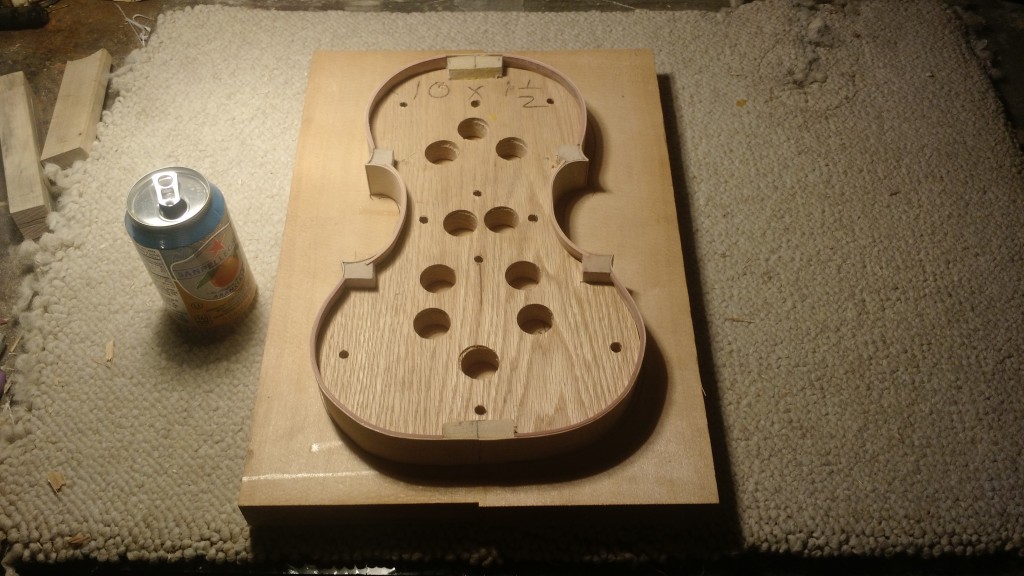
There’s the fiddle on it’s to-be top. Just a little bit of carving to do to make it happen!
*I realized I had no idea where the name came from, so I looked it up as I was writing this. The name was borrowed from a nearby castle made by the Hearst family. To my mind, the whole thing resembles Rivendell from the Lord of the Rings, but that’s to be expected. You can read all about it here: https://en.wikipedia.org/wiki/Wyntoon